
Okay, let’s talk about something nobody really warns you about before your first trip to Korea.
You land at Incheon Airport. You’re tired, maybe a little jet-lagged, and you need to find your hotel. You pull out your phone to open Google Maps — and there’s no signal. No data. Nothing.
That moment of panic? Completely avoidable. And honestly, sorting your SIM card in Korea before or right after you land is one of the best things you can do for yourself as a first-time visitor. Everything — maps, taxis, translation, restaurant searches — runs on mobile data. Get this right first, and the rest of the trip flows so much easier.
First, Know This: Korea’s Internet Is Genuinely Incredible
Before we get into the how, here’s something that’ll make you excited rather than stressed.
Korea has some of the fastest internet speeds in the world. We’re talking 5G coverage in most cities, 4G LTE even deep inside subway tunnels, and free WiFi absolutely everywhere — cafes, subway stations, convenience stores, parks, tourist attractions. You will never be far from a connection.
From my experience, the internet speed in Korea genuinely surprises most first-time visitors. You get used to maps loading instantly, videos streaming without buffering, and apps responding faster than they do back home. It’s one of those small things that makes daily life in Korea just feel… smooth.
That said — free WiFi is great as a backup, but you don’t want to be hunting for a login screen every time you need to check directions. Getting your own SIM card in Korea means you’re always connected, no matter where you wander.
Option 1: Buy Your SIM Card at Incheon Airport (Best for Most First-Timers)
The moment you clear customs at Incheon Airport, you’ll see telecom booths for Korea’s three main carriers right there in the arrivals hall — SK Telecom (SKT), KT, and LG U+. Both Terminal 1 and Terminal 2 have them.
Staff speak English, the tourist plans are clearly displayed, and the whole process takes about ten minutes. You walk out of the airport with a working Korean number and full data. Done.
Honestly? If you’re visiting Korea for the first time and you just want this sorted with zero stress, this is the move. I’d always tell first-timers to just head straight to one of these booths before they even think about the taxi queue.
Tourist SIM plans typically include unlimited data (with daily high-speed limits of 1–3GB, then slower unlimited speed after that), a Korean phone number, and validity from 5 days up to 30 days. Prices generally run between 20,000–40,000 won depending on how long you’re staying.
For everything else you need to navigate from the moment you land, our Incheon Airport to Seoul: First-Timer’s Complete Transport Guide has you covered.
Option 2: Get an eSIM Before You Leave Home (Smoothest Option Overall)
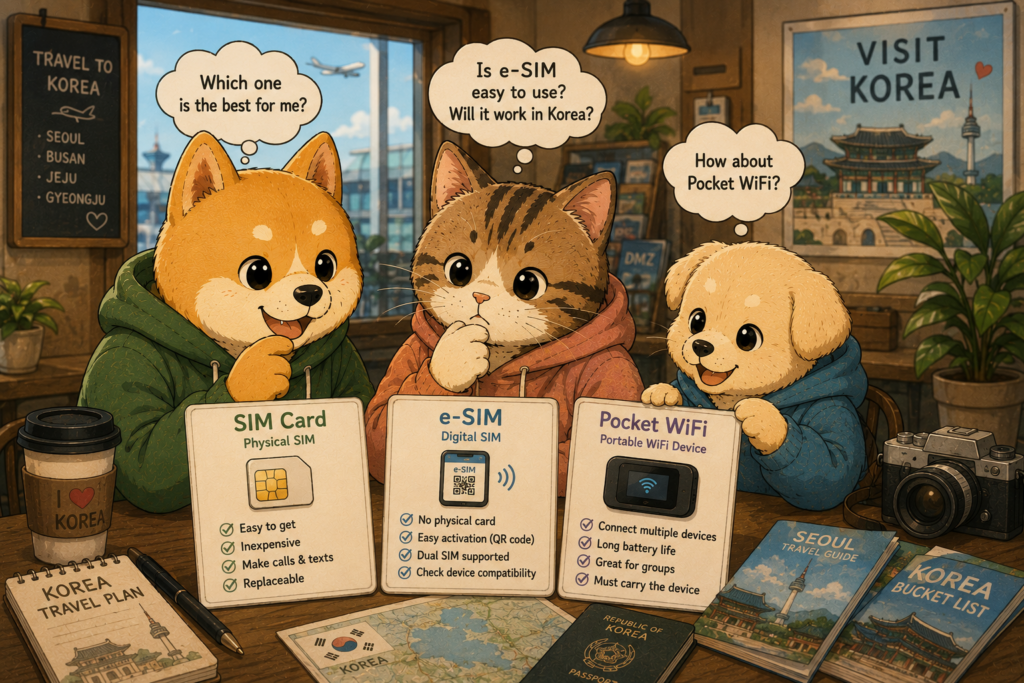
If your phone supports eSIM — most phones made after 2020 do — this is genuinely the easiest way to handle your SIM card in Korea situation.
An eSIM is a digital SIM. No physical card, nothing to swap out. You buy it online before your trip, scan a QR code, and it installs directly onto your phone. The moment your plane touches down in Korea, you turn it on and you’re connected. You don’t queue at any booth. You don’t wait for anything. You just… have internet.
Here’s what I always tell people who ask me about this — buy the eSIM a few days before you fly, but don’t activate it until you actually land in Korea. Activation starts the clock on your plan, so switching it on while you’re still at home means burning through days you could be using on the ground.
According to Trazy’s Korea SIM and eSIM guide, eSIMs have become the most popular connectivity option for visitors to Korea — and it’s easy to see why. Popular providers include Airalo and Klook, both widely used by international travelers heading to Korea.
Option 3: Pocket WiFi (Works Best for Groups)
Traveling with family or a group? Renting a pocket WiFi device at the airport might actually save you money compared to buying separate SIM cards for everyone.
One device, multiple phones connected. Pick it up at the rental counter after you land, carry it through the day, return it before you fly home.
The catch — and it’s a real one — is that someone always has to carry the device. If your travel partner wanders off to a different floor of a department store, suddenly nobody has WiFi. It’s a small thing that gets annoying faster than you’d expect.
For solo travelers or couples, a SIM card in Korea is almost always the cleaner option. For families with young kids, our Korea Travel with Kids: First-Timer’s Complete Family Guide has more on staying organized and connected as a group.
Physical SIM vs eSIM: Quick Comparison
| Physical SIM | eSIM | |
|---|---|---|
| Where to buy | Airport telecom booths, convenience stores | Online before travel |
| Setup | Staff help you at the counter | Scan QR code yourself |
| Works on all phones? | Yes | Requires eSIM-compatible phone |
| Korean phone number | Yes | Depends on provider |
| Best for | First-timers who want help | Frequent travelers, tech-comfortable |
| Price range | 20,000–40,000 won | Similar range |
If your phone supports eSIM → go eSIM, set it up before you leave.
If you’re not sure or your phone is older → physical SIM at the airport is safe and easy.
How Much Data Do You Actually Need?
This is worth thinking about before you buy, because getting the wrong plan is annoying.
- Short trip under 7 days → A 5GB plan covers most people for maps, messaging, and light browsing
- 7–14 days → Go unlimited. You’ll use more than you think, especially with navigation running constantly
- Heavy users — constant maps, video calls, streaming → Unlimited only, no question
I’ll be real with you — don’t cheap out on data in Korea. You’re going to be on your phone way more than usual. Maps running in the background, translation apps, searching for places to eat, messaging people back home. A slightly bigger plan than you think you need is always worth it. Running out of high-speed data on day three of a ten-day trip is not fun.
Can You Buy a SIM Card at a Convenience Store?
Yes — CU and GS25 sell basic prepaid SIM cards 24 hours a day. If you somehow miss the airport booths or land at an odd hour, it’s a solid backup.
That said, the selection is limited and there’s no one to help you set it up. For first-time visitors, the airport telecom booths are a much smoother experience. But good to know the option exists.
Once your SIM card in Korea is sorted and you’re connected, the next step is getting the right apps on your phone. Our Best Korea Travel Apps for First-Time Visitors has everything you need to download before you start exploring.
FAQ
Where can I buy a SIM card in Korea?
The easiest option for first-time visitors is the telecom booths at Incheon Airport arrivals hall — SKT, KT, and LG U+ all have counters there. You can also buy eSIMs online before your trip, or pick up basic prepaid SIMs at CU and GS25 convenience stores.
How much does a SIM card in Korea cost?
Tourist SIM cards typically cost between 20,000 and 40,000 won depending on the plan length and data amount. eSIMs from providers like Airalo and Klook are in a similar price range.
Should I get an eSIM or a physical SIM card in Korea?
If your phone supports eSIM, go with an eSIM — buy it before you travel and activate it when you land. It’s the smoothest option. If your phone doesn’t support eSIM or you want help setting things up, the airport telecom booths are easy and reliable.
Is free WiFi easy to find in Korea without a SIM card?
Korea has free WiFi almost everywhere — subway stations, cafes, convenience stores, tourist spots. But relying on free WiFi alone for navigation and apps can be unreliable. Having your own SIM card in Korea means consistent, fast connection wherever you go.
Can I buy a SIM card in Korea at a convenience store?
Yes. CU and GS25 sell basic prepaid SIM cards 24 hours a day. For first-time visitors though, the airport telecom booths offer better plan options and English-speaking staff who can walk you through the whole setup.