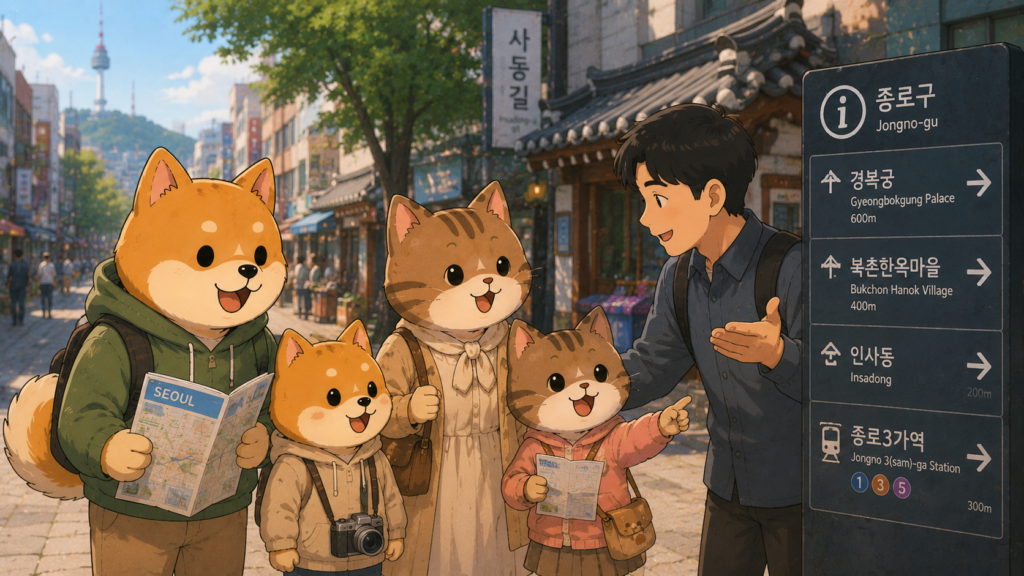
Useful Korean phrases for asking directions in Korea can make your trip much easier, especially if it is your first time visiting.
Korea is convenient for travelers, but directions can still feel confusing sometimes. Subway stations can be large, exits can be far apart, and some buildings have several entrances connected through underground passages.
Even if you use Naver Map or KakaoMap, there may be moments when you want to ask a real person for help.
The good news is that you do not need to speak perfect Korean.
A few simple Korean direction phrases, a polite tone, and your phone map are usually enough.
This guide focuses on useful Korean phrases for asking directions in Korea, including how to ask where something is, how to understand simple answers, and what local habits can make communication easier.
1. Useful Korean Phrases for Asking Directions in Korea Start With “Excuse Me”
Before asking for directions, it is polite to get someone’s attention first.
The most useful phrase is:
저기요
Jeogiyo
Excuse me
You can use “jeogiyo” when you want to ask a stranger, store staff, restaurant worker, or station employee for help.
It is commonly used in Korea, and it feels more natural than suddenly starting your question.
A Small Local Tip
If you say “jeogiyo” softly and show your phone map, many Koreans will understand that you need help before you even finish your sentence.
Some people may feel shy about speaking English, but most will still try to help if you ask politely.
2. How to Ask “Where Is This?” in Korean
One of the most useful Korean phrases for asking directions in Korea is:
여기 어디예요?
Yeogi eodiyeyo?
Where is this?
This phrase is useful when you are pointing to your phone, map, hotel address, subway station, or restaurant name.
You can also say:
여기가 어디예요?
Yeogiga eodiyeyo?
Where is this place?
The meaning is very similar.
When to Use This Phrase
Use this phrase when:
- You are lost
- You are checking your current location
- You are showing a place on your phone
- You want to confirm if you are in the right area
A Local Tip About “Yeogi”
“Yeogi” means “here” in Korean.
Travelers often search for “yeogi meaning” or “yeogiseo meaning” because it appears in many daily phrases.
In direction situations, “yeogi” is very useful because you can point to your phone or your current location while asking.
3. How to Ask “Is This Here?” in Korean
Another useful phrase is:
여기 있어요?
Yeogi isseoyo?
Is it here?
This phrase can sound slightly direct, but it can still be useful if you are pointing at a map or address.
For example, you can show your phone and ask:
여기 있어요?
Yeogi isseoyo?
Is it here?
Better Travel Version
A more natural phrase for travelers is:
이 근처에 있어요?
I geuncheoe isseoyo?
Is it near here?
This is useful when you are looking for a cafe, pharmacy, restroom, subway exit, or restaurant.
A Korean Direction Tip
If you are not sure how to pronounce everything, do not worry too much.
Showing your phone while saying one short phrase is usually enough.
Koreans often understand the situation from the map, not just your pronunciation.
If you want more basic phrases for your trip, check our Korean Phrases for Travelers guide.
4. Useful Korean Phrases for Asking Where Something Is
These are simple and practical phrases travelers can use often.
화장실 어디예요?
Hwajangsil eodiyeyo?
Where is the restroom?
지하철역 어디예요?
Jihacheol-yeok eodiyeyo?
Where is the subway station?
버스 정류장 어디예요?
Beoseu jeongnyujang eodiyeyo?
Where is the bus stop?
출구 어디예요?
Chulgu eodiyeyo?
Where is the exit?
엘리베이터 어디예요?
Ellibeiteo eodiyeyo?
Where is the elevator?
택시 타는 곳 어디예요?
Taeksi taneun got eodiyeyo?
Where is the taxi stand?
A Practical Local Tip
For first-time travelers, “exit” is one of the most important words in Korea.
Subway exits can completely change your walking route.
If you leave from the wrong exit, you may need to cross a large road or walk much farther than expected.
If you are still learning Korean subway systems, read our How to Use Subway in Korea guide.
5. How to Ask “How Do I Get There?” in Korean
If you want to ask how to get somewhere, use this phrase:
어떻게 가요?
Eotteoke gayo?
How do I get there?
You can show your destination on your phone and say:
여기 어떻게 가요?
Yeogi eotteoke gayo?
How do I get here?
This is one of the most useful Korean phrases for asking directions in Korea because it works in many situations.
When This Phrase Is Useful
Use it when asking about:
- Subway routes
- Walking directions
- Bus stops
- Taxi pickup points
- Nearby tourist spots
- Restaurants or cafes
A Local Tip for Using This Phrase
If someone gives you a long answer in Korean, do not panic.
You can simply listen for key words like:
- 왼쪽: left
- 오른쪽: right
- 직진: go straight
- 출구: exit
- 지하철: subway
You do not need to understand every word to follow the basic direction.
6. Korean Direction Words Travelers Should Know
You may not understand full Korean sentences, but knowing a few direction words helps a lot.
왼쪽
Oenjjok
Left
오른쪽
Oreunjjok
Right
직진
Jikjin
Go straight
여기
Yeogi
Here
저기
Jeogi
Over there
근처
Geuncheo
Nearby
앞
Ap
In front
뒤
Dwi
Behind
안
An
Inside
밖
Bakk
Outside
A Simple Way to Remember
You do not need to memorize everything at once.
For travel, the most useful words are:
- left
- right
- straight
- exit
- here
- nearby
If you remember only those, asking for directions in Korea becomes much easier.
7. Useful Korean Phrases for Subway Directions
Subway stations are where many travelers need direction help the most.
Korean subway stations can be large and confusing, especially in Seoul.
몇 번 출구예요?
Myeot beon chulgu-yeyo?
Which exit number is it?
2번 출구 어디예요?
I-beon chulgu eodiyeyo?
Where is Exit 2?
이 방향 맞아요?
I banghyang majayo?
Is this the right direction?
갈아타야 해요?
Garataya haeyo?
Do I need to transfer?
여기서 내려요?
Yeogiseo naeryeoyo?
Do I get off here?
A Korean Subway Tip
“Yeogiseo” means “from here” or “at here,” depending on the sentence.
For example:
여기서 내려요?
Yeogiseo naeryeoyo?
Do I get off here?
This is useful when you are unsure whether you should leave the train or stay on.
If you rely on public transportation during your trip, use map apps together with simple Korean phrases. For app recommendations, check our Best Apps for Traveling in Korea guide.
8. How to Ask for Help at a Store, Cafe, or Hotel
Sometimes the easiest way to ask for directions is not asking a random person on the street.
It may be easier to ask staff at a:
- Hotel
- Cafe
- Convenience store
- Subway station
- Tourist information center
- Department store
여기 어떻게 가요?
Yeogi eotteoke gayo?
How do I get here?
이 주소 어디예요?
I juso eodiyeyo?
Where is this address?
택시 불러주세요
Taeksi bulleojuseyo
Please call a taxi
가까워요?
Gakkawoyo?
Is it close?
멀어요?
Meoreoyo?
Is it far?
A Local Tip About Asking Staff
Hotel staff are usually the best people to ask if you need clear directions.
They can write the address in Korean, explain the nearest subway exit, or help you show a taxi driver the destination.
If you are staying in a small guesthouse or hotel, ask before you leave for the day.
It can save you time later.
9. Useful Korean Phrases for Taxi Directions
Taxis are helpful when you are tired, carrying luggage, or traveling with parents.
But pronunciation can be difficult with Korean addresses.
The easiest method is to show the destination on your phone.
여기로 가주세요
Yeogiro gajuseyo
Please go here
이 주소로 가주세요
I jusoro gajuseyo
Please go to this address
여기서 세워주세요
Yeogiseo sewojuseyo
Please stop here
천천히 가주세요
Cheoncheonhi gajuseyo
Please go slowly
A Practical Taxi Tip
Do not try to pronounce long Korean addresses if you are not confident.
Showing the Korean address on your phone is much easier.
Many taxi drivers prefer seeing the exact Korean address instead of hearing a place name in English.
If you plan to use taxis during your trip, Naver Map, KakaoMap, and Kakao T can help a lot.
10. What to Do If You Still Feel Lost
Even with useful Korean phrases for asking directions in Korea, you may still feel confused sometimes.
That is normal.
Some subway stations are large, and some neighborhoods have small alleys or multiple building entrances.
Step-by-Step Help
If you feel lost:
- Move to the side first
- Open Naver Map or KakaoMap
- Check the exit number
- Screenshot your destination
- Ask someone politely
- Use a translation app if needed
When You Need Official Travel Help
If you need tourist information or communication help, you can use the official 1330 Korea Travel Helpline.
It can be useful when you need travel information, interpretation help, or guidance while traveling in Korea.
A Reassuring Local Tip
Do not feel embarrassed about asking for help.
Many Koreans may not speak English fluently, but they often try to help by pointing, checking a map, or walking you toward the right direction.
A polite attitude matters more than perfect Korean.
11. Common Mistakes When Asking Directions in Korea
Travelers usually make small mistakes, but they are easy to avoid.
Asking Without Showing the Address
If you only say the English name of a place, some people may not recognize it.
Show the Korean name or address if possible.
Standing in the Middle of a Busy Subway Path
Subway stations can be crowded.
Step aside before checking your phone or asking for help.
Forgetting the Exit Number
Exit numbers matter a lot in Korea.
Always check the correct exit before leaving the station.
Relying Only on Google Maps
Google Maps can be useful, but Naver Map or KakaoMap often gives better local route details in Korea.
Asking Too Complicated Questions
Short phrases work better.
Instead of a long sentence, show your phone and say:
여기 어떻게 가요?
Yeogi eotteoke gayo?
How do I get here?
Simple is better.
12. Quick Phrase List for Asking Directions in Korea
Here is a quick list you can save before your trip.
Excuse me
저기요
Jeogiyo
Where is this?
여기 어디예요?
Yeogi eodiyeyo?
How do I get here?
여기 어떻게 가요?
Yeogi eotteoke gayo?
Where is the restroom?
화장실 어디예요?
Hwajangsil eodiyeyo?
Where is Exit 2?
2번 출구 어디예요?
I-beon chulgu eodiyeyo?
Is this the right direction?
이 방향 맞아요?
I banghyang majayo?
Is it near here?
이 근처에 있어요?
I geuncheoe isseoyo?
Please go here
여기로 가주세요
Yeogiro gajuseyo
Please stop here
여기서 세워주세요
Yeogiseo sewojuseyo
13. Final Thoughts
Useful Korean phrases for asking directions in Korea can make your trip feel much less stressful.
You do not need to speak Korean perfectly.
In most situations, simple phrases, your phone map, and polite body language are enough.
The most useful words are “jeogiyo,” “yeogi,” “eodiyeyo,” “eotteoke gayo,” and “chulgu.”
If you remember just a few phrases, you can ask where the restroom is, find the right subway exit, confirm a taxi destination, or ask how to get somewhere.
Korea is generally traveler-friendly, and many people will try to help if you ask politely.
A little Korean can make your travel day smoother, warmer, and more comfortable.
FAQ
What are the most useful Korean phrases for asking directions in Korea?
The most useful phrases include “저기요” for excuse me, “여기 어디예요?” for where is this, and “여기 어떻게 가요?” for how do I get here.
What does “yeogi” mean in Korean?
“Yeogi” means “here” in Korean. It is very useful when asking directions because you can point to a place on your phone or map.
What does “yeogiseo” mean in Korean?
“Yeogiseo” usually means “from here” or “at here,” depending on the sentence. For example, “여기서 내려요?” means “Do I get off here?”
How do I ask where the restroom is in Korean?
You can say “화장실 어디예요?” which means “Where is the restroom?”
Can I ask Koreans for directions if I do not speak Korean well?
Yes. Many Koreans will try to help if you ask politely, especially if you show your phone map or destination address.
답글 남기기