
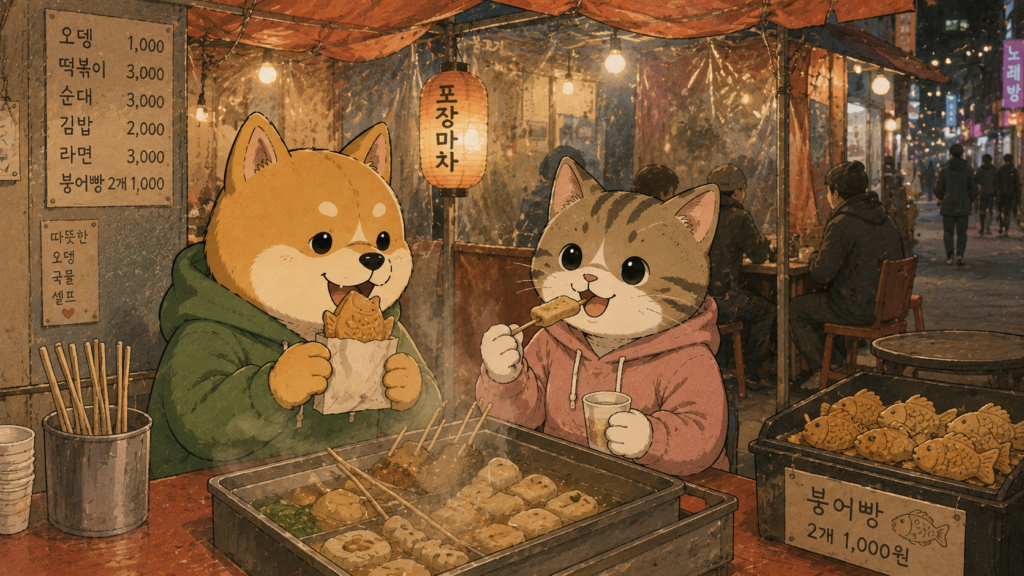
If there’s one thing first-time visitors to Korea consistently say after their trip, it’s this: “I didn’t expect the street food to be that good.”
Korean street food isn’t just a quick snack between sightseeing stops. It’s loud, smoky, unpredictable, and honestly one of the best ways to understand what Koreans actually eat when no one’s watching. Hot rice cakes drenched in red sauce. Fish-shaped buns filled with sweet red bean. Potato spirals on sticks. And all of it sitting right there on the sidewalk, ready to eat with your hands.
But before you head straight to Myeongdong and spend twice as much as you need to — here’s what you actually need to know about Korean street food.
What Makes Korean Street Food Different
Korean street food has centuries of history behind it. Street vendors have been a core part of Korean market culture since the Joseon period, feeding working-class communities with fast, affordable, filling food. Today that tradition is alive in everything from pojangmacha (tented street stalls) to modern night markets along the Han River.
What sets it apart from street food in other Asian countries is the sheer consistency. Almost every stall sells the same core items — and they’re all good. The variation isn’t in what’s sold, but in the sauce levels, the toppings, and the occasional creative twist a vendor throws in.
According to Korea Tourism Organization’s official street food guide, Korean street food — known locally as bunsik — originally referred to flour-based dishes, but has grown to cover nearly any affordable food sold at stalls and carts across the country.
The Must-Try Korean Street Foods
Tteokbokki (떡볶이) — Spicy Rice Cakes
If you only try one Korean street food, make it this. Cylindrical rice cakes simmered in a thick, spicy-sweet gochujang sauce — sometimes with fish cakes, boiled eggs, or ramen noodles thrown in. It’s hot, chewy, a little addictive, and costs around 3,000–5,000 won per serving.
Fair warning: the “regular” spicy level at most stalls is genuinely spicy. If you’re sensitive to heat, look for the rose tteokbokki version (creamy, less spicy) which has become easier to find in recent years.
Eomuk / Odeng (어묵) — Fish Cake Skewers
Long sheets of fish cake folded onto skewers and simmered in broth. You eat the skewer and drink the broth from a small cup on the side. It’s salty, warming, and honestly one of my personal favorites when visiting Korea in winter — there’s something about standing at a street stall in the cold, holding a warm cup of eomuk broth with both hands, that just feels right. If you visit Korea between November and February, don’t skip this one.
Hotteok (호떡) — Sweet Pancakes
Dough filled with brown sugar, honey, cinnamon, and crushed nuts, then fried flat on a griddle until the outside is crispy and the inside turns into molten caramel. This is a winter street food, and you’ll smell the stalls before you see them. Plan to burn your tongue at least once.
Gimbap (김밥) — Korean Rice Rolls
Seaweed wrapped around rice, egg, pickled daikon, and vegetables. It looks a bit like sushi but tastes completely different — sesame oil, rice vinegar, and whatever fillings the vendor chose that morning. It’s filling, cheap, and easy to eat while walking.
Bungeo-ppang (붕어빵) — Fish-Shaped Buns
Pancake batter pressed into a fish-shaped mold and filled with sweet red bean paste. Crispy on the outside, soft and sweet in the middle. This is another one I personally look forward to every winter in Korea — along with eomuk, bungeo-ppang is the kind of street food that makes cold weather actually worth it. Costs around 1,000 won for two or three pieces, and some vendors now fill them with custard or chocolate instead of red bean if that’s more your style.
Dakkochi (닭꼬치) — Grilled Chicken Skewers
Chunks of chicken threaded onto bamboo skewers, grilled over charcoal, and brushed with sweet soy or spicy sauce. Usually around 2,000–3,000 won per skewer. Simple, satisfying, and one of the safest options if you’re still figuring out how spicy you can actually handle Korean food.
Twigim (튀김) — Korean Fried Snacks
Battered and fried vegetables, shrimp, squid, and glass noodle rolls. Similar to Japanese tempura but heavier and more filling. Usually sold next to tteokbokki stalls — you’re supposed to dip the fried pieces into the tteokbokki sauce. Do it. It’s one of those combinations that shouldn’t work but absolutely does.
Tornado Potato (회오리 감자)
A whole potato cut in a spiral, spread onto a long stick, deep-fried until golden and crispy, then dusted with seasoning powder. It’s dramatic to look at, fun to eat, and extremely popular in Myeongdong with tourists and locals alike.
Myeongdong vs. Traditional Markets: Where to Eat (And Where to Save Money)
Here’s something worth knowing before you go: Myeongdong is great for Korean street food, but it’s the most expensive place to eat it.
The stalls are clean, well-lit, and easy to navigate in English — but you’ll pay a tourist premium. A serving of tteokbokki or a tornado potato in Myeongdong can run 1,000–2,000 won more than the exact same item a few stops away. And that adds up quickly if you’re snacking your way through the city.
The better value is at Seoul’s traditional markets. Places like Gwangjang Market, Namdaemun Market, and Tongin Market offer the same street food — sometimes better — at noticeably lower prices and with more local atmosphere. A plate of bindaetteok (mung bean pancakes) at Gwangjang goes for about 4,000–5,000 won. That same experience in Myeongdong? You’d pay more and wait in a longer line.
If you’re planning a full day around street food and markets, our Korean Traditional Markets Guide has everything you need on where to go and what to order.
A Local Tip About Greetings (That Actually Gets You More Food)
Here’s something most travel guides won’t tell you: in Korea, a simple greeting goes a long way — further than you might expect.
Saying 안녕하세요 (annyeonghaseyo) — just “hello” — when you approach a street food stall or a small restaurant makes a real difference. Koreans genuinely appreciate the effort from foreign visitors, and it’s not unusual to get a slightly larger serving, a small side dish thrown in, or a vendor who goes out of their way to help you pick something you’ll like. It happens more than you’d think.
You don’t need perfect pronunciation. The attempt alone signals respect, and respect matters in Korean culture. If you want a few more phrases that are actually useful out in the city, check out our Korean Phrases Guide for Travelers.
How to Order at a Street Food Stall
Most Korean street food stalls work the same way:
- Walk up, point at what you want, hold up fingers for quantity
- Pay cash (smaller stalls often don’t accept cards)
- Eat standing at the stall or find a nearby bench
Very few stalls have English menus, but most vendors in tourist-heavy areas are used to non-Korean speakers. Pointing works. Photos on your phone work. And if you mispronounce something completely, the vendor will usually figure it out and respond with patience.
One thing to check: some larger market stalls now have QR menus or photos displayed on a board above the stall. If you’re confused, look up before you point.
Budget: How Much Should You Spend?
Korean street food is genuinely affordable. A full snack session — three or four items — usually runs between 8,000 and 15,000 won (roughly $6–11 USD) depending on where you eat.
General price range per item:
- Tteokbokki: 3,000–5,000 won
- Eomuk skewer: 500–1,000 won
- Hotteok: 1,000–2,000 won
- Gimbap (one roll): 1,500–3,000 won
- Dakkochi: 2,000–3,000 won
- Tornado potato: 3,000–5,000 won (higher in Myeongdong)
For a broader look at how much to budget for food across your whole trip, our Korea Travel Budget Guide breaks it down day by day.
FAQ
What is the most popular Korean street food?
Tteokbokki (spicy rice cakes) is widely considered the most iconic Korean street food. It’s available at nearly every street stall across the country and comes in dozens of variations from extra spicy to creamy and mild.
Where is the best place to eat Korean street food in Seoul?
Myeongdong is the most well-known area, but Gwangjang Market, Namdaemun Market, and the Hongdae area offer more authentic and better-value Korean street food with fewer tourist crowds.
Is Korean street food spicy?
Many Korean street foods are spicy, especially tteokbokki and anything with gochujang sauce. However, not all street food is spicy — gimbap, hotteok, bungeo-ppang, and eomuk are all mild and suitable for people who can’t handle heat.
How much does Korean street food cost?
Most Korean street food items cost between 1,000 and 5,000 won (under $4 USD). A satisfying snack session of three to four items typically costs 8,000–15,000 won depending on the area.
Can you eat Korean street food without speaking Korean?
Yes, easily. Pointing, using fingers for quantity, and showing photos on your phone all work well. Most vendors in busy areas are experienced with non-Korean speaking visitors.